
Buying & SellingPropTrak Editorial
The Complete Property Transaction Checklist: From Token Money to Registration
A practical India checklist for a property sale: token money, title checks, the agreement to sell, TDS, stamp duty, sub-registrar registration and what to do after the sale deed.
Most property deals in India do not fail at the site visit. They stall in the stretch between the first token and the day the sale deed is registered — a missing title paper, a token receipt that says nothing about a refund, a loan that disburses late, or stamp duty calculated on the wrong value. This checklist walks that stretch in order, for buyers, sellers and the people coordinating the deal.
It follows a typical resale or fresh sale of a flat or house. Agricultural land, a gift, a family partition and a lease are different transactions. If you are documenting a tenancy, use the rent agreement workflow rather than a sale deed. Rules also differ by state. Circle rates, stamp duty concessions and the sub-registrar’s checklist in Haryana are not the same as those in Maharashtra, Karnataka or Uttar Pradesh. Treat the steps below as the sequence to complete, then confirm the local form, fee and identity requirement before you pay.

What happens between token and registration
A completed sale of immovable property in India is not the agreement, the token or the WhatsApp confirmation. Under the Transfer of Property Act, a sale of tangible immovable property of meaningful value is completed by a registered instrument. Until that registered sale deed is executed, ownership has not passed, even if money has moved and keys have been handed over.
A clean deal usually moves through eight stages:
- Freeze the commercial terms and collect the seller’s document set.
- Pay token or earnest money against a written receipt.
- Complete title, approval and dues diligence before the large payments.
- Sign an agreement to sell that locks price, timeline and default terms.
- Line up the home loan, close the seller’s existing mortgage, and plan TDS.
- Draft the sale deed on the same facts as the agreement.
- Pay stamp duty and registration fee, and execute the deed at the sub-registrar.
- Mutate the property, transfer utilities and store the originals.
PropTrak is built around that same journey. The real estate sale transaction keeps the memorandum, agreement to sell, approvals, property-document checks, payments, e-stamping, Aadhaar e-signing and the final sale deed on one checklist, so a step is not left in someone’s inbox.
Before any money moves
Do this before the token, not the night before registration. A short delay at this stage is cheaper than a title dispute after you have paid 10 or 20 percent of the price.
Identify the property the way the records do
A marketing name is not a legal description. Note all of the following, and make sure every later document uses the same ones:
- Building or project name, tower, floor and flat or unit number.
- Survey, khasra, municipal or city survey number, as applicable.
- Carpet, built-up and super built-up area, and what the price is quoted on. Carpet area is the figure that should drive the conversation for apartments.
- Parking, whether it is an independent slot with its own legal basis or only a licence from the association.
- Whether the seller is the sole owner, a joint owner, a company, an HUF, a guardian, or someone acting under a power of attorney.
Meet every person who must sign
If a spouse, parent, sibling or company is on the title, that person must sign the agreement and the sale deed, or there must be a valid, specific authority to sign for them. A general claim that “my brother is abroad and I look after it” is not authority. A broad power of attorney is also not a substitute for a sale. Indian courts have been clear that arrangements built only on a sale agreement, a general power of attorney and a will do not convey title. Insist on a registered sale deed from the person who actually owns the property.
Fix the commercial terms in writing
Agree these points before the token receipt is signed:
- Total price, and whether it includes parking, club, maintenance deposit and GST. On many under-construction homes, GST is extra and is the buyer’s cost.
- What is being sold as fixtures — modular kitchen, air-conditioners, wardrobes — and what the seller will remove.
- Payment schedule: token, agreement stage, loan tranche, and the balance on or before registration.
- Who pays stamp duty, registration fee, TDS deposit charges, society transfer charges and unpaid property tax.
- Target date for the agreement, for vacant possession and for registration.
- Whether the buyer is using a home loan, and whether the seller has an existing loan to close.
Token money, earnest money and the receipt

“Token”, “bayana” and “earnest money” are used loosely in the market. They are not the same thing in a dispute.
- Token money is the small amount paid to show that the buyer is serious and to hold the negotiation. It should be adjustable against the price.
- Earnest money is a larger advance paid under a contract, often to show commitment. Whether the seller may keep it if the buyer walks away depends on what the signed contract says, and on whether that term is a genuine pre-estimate of loss or an unfair penalty. Silence in a one-line receipt is the usual source of fights.
- Advance against the price is simply part of the consideration. It is normally refundable if the seller cannot complete, unless the buyer has defaulted under a written clause.
Pay by account-payee cheque, NEFT or RTGS. Keep the bank proof. Large cash payments are a compliance problem as well as a practical one: receiving ₹2 lakh or more in cash, in respect of one transaction, can attract penalty under the income-tax rules on cash receipts. A cash token with no receipt is very hard to recover.
What the token receipt must say
Do not accept “Received ₹1,00,000 as token for the flat.” The receipt, signed by every owner who is taking the money, should record:
- Full names, addresses and PAN of the payers and the receivers.
- A description that identifies the property, not just the project nickname.
- The amount, the mode of payment and the date.
- That the amount is adjustable against the total price, and the total price itself.
- The date by which the agreement to sell will be signed.
- The date by which the seller will share the title set for checking.
- In what cases the token is refunded, and in what cases it may be forfeited.
- That the seller has not already taken a token for the same property from someone else.
If the seller will not put the refund terms in writing, treat that as the diligence result. Do not “sort it later” after a larger cheque.
On a customer-led sale, buyers and sellers can start the transaction themselves and keep the receipt, the later agreement and the payment trail in one place. Brokers coordinating several deals usually need the same facts repeated without a new spreadsheet for every client — that is what the broker sale workflow is for.
Title and document checklist
Pay the larger agreement advance only after these documents have been read, not after they have been promised. For an apartment, ask the seller (or the builder, on a fresh booking) for copies first and inspect originals before registration.
| Document | What you are checking |
|---|---|
| Chain of sale deeds | The current owner traces back to the previous owner, the builder or the development authority without a break. Read the latest deed and the one before it at minimum, and go further if the latest deed is recent. |
| Encumbrance certificate | Registered dealings at the sub-registrar for a long window, often 13 to 30 years. It shows registered mortgages and sales. It does not show every court case or unregistered family arrangement. |
| Revenue and municipal records | Mutation, jamabandi, khata or property-tax assessment matches the seller’s name. A mismatch is a reason to pause, not a reason to ignore the title. |
| Approved plan, commencement and occupancy or completion certificate | The flat you are buying exists on the sanctioned plan. Extra floors, enclosed balconies and converted servant rooms are a common gap between the brochure and the approval. |
| RERA registration, for an ongoing project | The project is registered, the promoter matches the seller, and the possession timeline and approved plan on the state RERA portal match what you were told. |
| Society or association papers | Share certificate, no-dues letter, and a no-objection for transfer where the bylaws require it. Ask for the last 12 months of maintenance receipts. |
| Loan and mortgage papers | If a bank holds the original deed, the seller must produce a sanction-to-close the loan and a timeline for the release. The original deed should come to the buyer, or to the buyer’s bank, at registration. |
| Tax and utility bills | Property tax, water and electricity are paid up to date. Arrears often stay with the property even after you become the owner. |
| Identity of every seller | PAN and an officially valid identity document. For a company, a board resolution. For a minor owner, court permission. For an NRI seller, the tax and banking route confirmed before the agreement is signed. |
Two searches sit outside the seller’s file. Ask a local advocate to check for pending litigation against the property and the seller in the courts that actually hear those cases, and to read the sub-registrar index in the seller’s and previous owners’ names. An encumbrance certificate is necessary and not sufficient.
On PropTrak, property-document verification is a step in the sale checklist, including on builder-led inventory sales, so the approval is recorded against the transaction rather than attached to a chat thread.
The agreement to sell

An agreement to sell is a contract that a sale will happen on the terms you have settled. It gives the buyer a right to insist on the sale. It does not transfer ownership. Calling the document a “sale deed”, back-dating it, or paying most of the price under it does not change that. Ownership passes on execution of a properly stamped and registered sale deed.
Whether the agreement itself must be registered depends on the state. Several states require registration of an agreement for sale of immovable property, and an unregistered document can be difficult to use later if a dispute reaches court. Ask the local sub-registrar’s practice before you choose “we will only register the final deed”. Where registration of the agreement is required, budget for its stamp duty as well. In some states the stamp duty paid on a properly drawn agreement is adjusted when the sale deed is stamped. Confirm that adjustment in writing with the registration office; do not assume it.
Clauses worth slowing down for
- Parties and authority. Every owner, with PAN. If someone signs through an attorney, annex the power of attorney and check that it specifically authorises this sale.
- Property schedule. The same description you collected before the token, plus carpet area, parking and easements. Attach the plan if the unit is new.
- Price and payment schedule. Dates, modes and what “balance payable on registration” means if the bank disburses one or two days later.
- Title warranty. The seller confirms sole, marketable title, that the property is not mortgaged except as disclosed, and that there is no pending litigation or notice.
- Dues. Property tax, maintenance, electricity and water up to the possession date are the seller’s. Later periods are the buyer’s.
- Possession. Date of vacant physical possession, what happens to existing tenants, and a list of original documents to be handed over.
- Default. A dated cure period, a refund with interest if the seller cannot complete, and a forfeiture clause that is specific. Open-ended “seller may forfeit everything” language is how token disputes end up in court.
- Specific performance and termination. The buyer’s right to insist on the sale, and the limited cases in which either side may walk away without being in breach.
- Loan and TDS. The buyer’s right to pay through a housing loan, the seller’s duty to cooperate with the bank, and who deducts tax at source.
- Who drafts the sale deed. It must repeat the schedule, the price and the warranties. Do not let a fresh draft quietly drop a parking slot or a no-dues promise.
PropTrak starts from predefined templates for the memorandum, the agreement to sell and the sale deed, on the sale transaction workflow. Customers follow that guided set. Brokers and builders can edit templates where the deal needs a local clause, then route the draft through review and approval so both sides are working on the same version.
Payments, the home loan and TDS
Match every payment to the schedule in the agreement and take a receipt that mentions the property and the running balance. If you are the buyer and a bank is funding the purchase, get the sanction letter before you commit to a registration date. Banks will want the title set, the agreement, your KYC and, on the day, a sale deed they have cleared. Registration often happens with the buyer, the seller and the lending bank’s process moving together. Leaving the bank out of the draft is a reliable way to lose the appointment.
If the seller’s own loan is still open, the usual closure is: the buyer’s bank or the buyer pays the outstanding directly to the seller’s lender, the lender hands over the original deeds and a release, and the sale deed is registered immediately after. Get the outstanding figure and the release timeline in writing before the agreement date.
Tax deducted at source on the purchase
When you buy immovable property other than rural agricultural land from a resident seller, section 194-IA of the Income-tax Act generally requires the buyer to deduct tax. No deduction is required only where the consideration and the stamp-duty value are both below ₹50 lakh. If either figure is ₹50 lakh or more, deduct tax at 1 percent of the higher of the consideration and the stamp-duty value. Where there is more than one buyer or seller, the consideration is the aggregate, not each person’s share looked at alone.
- The buyer deducts. The seller does not “take care of it later”.
- The buyer does not need a TAN. Deposit the tax using Form 26QB and the buyer’s PAN, and give the seller Form 16B.
- The deposit is due within the time the rules prescribe from the end of the month in which you deducted. Do not wait until after registration to start the process if you have already paid a large instalment.
- If the seller does not furnish PAN, a higher deduction rate applies. Collect PAN before the first adjustable payment.
- If the seller is a non-resident, section 194-IA is the wrong section. Deduction is under the non-resident payment rules and the rate is often higher. Get a chartered accountant to compute it before the token is even adjusted.
Token and later instalments that form part of the price count toward the consideration. Plan the deduction so the total tax deposited equals the required 1 percent of the higher value, and ask your tax adviser which instalment should carry the deduction. The seller’s net receipt will be price minus that tax. Write that mechanic into the payment schedule so nobody treats the TDS as an extra amount on top of the price.
Where payments are held between the two sides until a condition is met, an escrow step keeps that money tied to the checklist. Escrow on PropTrak is the default for a sale the customer starts, and optional when a broker or builder starts the transaction.
Stamp duty and the registration day
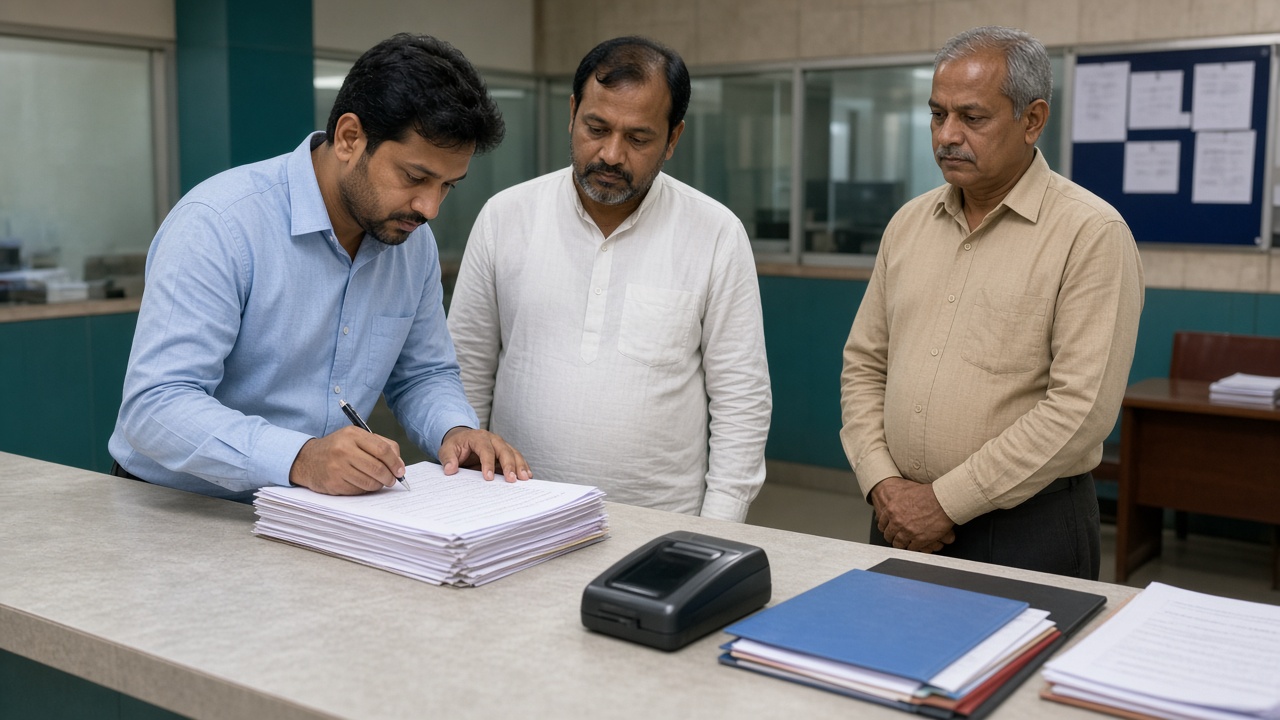
Stamp duty is a state levy. It is charged on the instrument, and the value is generally the higher of the price in the deed and the circle, collector or ready-reckoner rate for that locality and use. Under-reporting the price does not reduce duty if the circle rate is higher, and it creates a separate income-tax problem for both sides. Some states give a concession when the property is bought in a woman’s name, or a small difference between joint names and a single name. Those concessions change. Check the rate on the state registration department’s calculator for the year you will execute the deed.
Registration fee is separate from stamp duty. Budget both, plus scanning charges where the office levies them. In most states, duty is paid by e-stamp before the appointment. The sale workflow can include e-stamping and Aadhaar-based e-signing as part of closing, either by generating the e-stamp or by uploading one you already hold, and then completing execution instead of moving the file to a separate signing tool.
Build the appointment around this list
- Sale deed draft approved by both sides and, if there is a loan, by the buyer’s bank. Names, PAN, area and schedule match the agreement.
- Stamp duty and registration fee paid, with receipts.
- Original identity documents and PAN of every buyer and seller, plus photographs in the format the state portal asks for.
- Two witnesses with identity documents, unless the local office has a different published requirement. Witnesses should not be people who are themselves parties.
- Previous original title deeds, the encumbrance certificate, the no-dues and society letter, and the seller’s loan-closure or release letter if a mortgage is being paid off.
- TDS challan if you have already deposited tax on an earlier instalment, and a plan for the deduction on the registration-day payment.
- Slot booked on the state registration portal in the names that appear in the deed. A mismatch in spelling with Aadhaar is a common reason appointments are refused.
On the day, the parties admit execution. Offices capture photographs and fingerprints. Read the final printed deed once more before you sign, especially the schedule, the consideration and any clause that says the seller has already handed over possession. Collect the registration receipt or endorsement before you leave. Certified copies are applied for afterwards; do not leave the only proof of registration with an intermediary you do not know.
Physical possession can be the same day or a later date written into the deed. If keys are handed over, record the meter readings and a short list of fixtures. If a tenant remains, the sale transfers the landlord’s interest subject to that tenancy — it does not end the tenant’s rights. Documenting that relationship is a rental matter, which is why sale and rent documentation should not be forced into one template.
After the sale deed is registered

The deed is the turning point, and it is not the last form.
- Certified copy. Apply for a certified copy of the registered deed and keep a scan. If a bank financed the purchase, the bank will usually retain the original until the loan is closed.
- Mutation. Apply to the municipal body and, where the land records require it, the revenue office, so property tax and the record of rights show the buyer. A registered deed does not update those records by itself.
- Society or association. Complete the transfer, pay the transfer fee the bylaws actually provide for, and get the share certificate or membership in the buyer’s name.
- Utilities. Move electricity, water, piped gas and internet. Clear the seller’s security deposit in writing so it is not mixed into a later bill dispute.
- Tax records. The buyer keeps the sale deed, the TDS certificate and the payment proofs. The seller reports the transfer in the return for that year. Indexation, exemptions and the treatment of an under-construction home depend on facts a chartered accountant should apply to that seller.
- Address and locker. Store originals with the person who is actually responsible for them. A photocopy in a family WhatsApp group is not a backup plan.
The full checklist
Use this as the working list from the first meeting to the week after registration.
| Stage | Done only when |
|---|---|
| Commercial terms | Price, area, parking, GST, who pays duty and fees, and the dates for agreement, possession and registration are written down. |
| Parties | Every legal owner is identified. Authority, company resolution or court permission is in the file before anyone signs. |
| Token | Paid through a bank channel. Receipt states the property, the total price, adjustment, the agreement deadline, and refund or forfeiture. |
| Title set | Chain of deeds, encumbrance certificate, mutation or khata, plan approvals, occupancy certificate, RERA record where it applies, and a litigation check. |
| Dues and mortgage | Property tax and maintenance are clear. Any existing home loan has a closure figure and a release plan. |
| Agreement to sell | Signed by all parties, stamped and, where the state requires it, registered. Payment, default, possession and document handover are specific. |
| Loan and TDS | Buyer’s sanction is in hand. TDS under section 194-IA, or the non-resident provision if the seller is an NRI, is computed and scheduled against payments. |
| Sale deed | Draft matches the agreement. Duty is calculated on the higher of price and circle rate. Fee receipts are ready. |
| Registration | Parties and witnesses are present with identity documents. Biometrics are done. Registration receipt is collected the same day. |
| After registration | Certified copy, mutation, society transfer, utility transfer and a stored original or bank acknowledgement. |
Who should own which part of the list
The buyer owns diligence, funds, TDS and being present for registration. The seller owns a clear title, originals, lien closure and vacant possession on the agreed date. Neither side should discover the other’s job at the sub-registrar’s counter.
A buyer or seller running their own deal can follow a fixed checklist and fixed templates without assembling the process. That is the customer workflow. A broker who starts the transaction for a client needs the same milestones, with room to adjust the checklist and the draft, which is how broker-initiated sales are set up. A builder selling across a project needs those steps repeated without each booking inventing a new document path — builder sale operations are designed for that volume. In broker- and builder-started transactions, buyer and seller details stay hidden inside the workflow.
If you want this checklist running as a live transaction rather than a document on a laptop, you can start a sale transaction or review sale pricing for customers, brokers and builders. More practical notes sit on the PropTrak blog.
Questions people ask at the token stage
Does paying token money make me the owner?
No. Token money, even a large amount, does not transfer title. Ownership of a flat or house passes when a sale deed is executed and registered in accordance with law.
Can the seller keep my token if I change my mind?
Only if a written term says so, and only to the extent that term is enforceable. A receipt that never mentions forfeiture does not give the seller a clear right to keep the money. A clause that keeps an amount out of proportion to any real loss can be challenged. Write the consequence down while the amount is still small.
Should I register the agreement to sell or only the sale deed?
Register the sale deed in every case. Also register the agreement where your state requires it, and strongly consider it even where you are told it is optional, because an unregistered agreement is a weak document in a dispute. Ask the local registration office before you skip that step.
What if the circle rate is higher than the price we agreed?
Duty and, in many cases, the value used for tax are based on the higher figure. Revisit the price or the duty budget before registration. Do not sign a deed that states a value you did not pay and cannot explain.
We are only renting, not buying. Does this list apply?
The title habit is still useful, but the document, stamp duty and registration path are different. Use a rent agreement, with its own renewal and e-sign steps, rather than adapting a sale deed. For a letting in the capital, the Delhi rent agreement guide covers duty, registration and the clauses to include.
This is a practical sequence for a private sale of a flat or house in India. It is not legal, tax or registration advice. Stamp duty, circle rates, concessions, portal forms and identity rules differ by state and change. Have a local advocate read the title and the deed, and a chartered accountant confirm TDS, before you pay the token or book the registration slot.